1
/
of
1
HFTCODE.COM
Bitcoin Futures, Volatility Analytics & IBKR Integration — C++17 Technical Guide & Code Architecture (PDF)
Bitcoin Futures, Volatility Analytics & IBKR Integration — C++17 Technical Guide & Code Architecture (PDF)
Regular price
$0.00 USD
Regular price
Sale price
$0.00 USD
Quantity
Couldn't load pickup availability
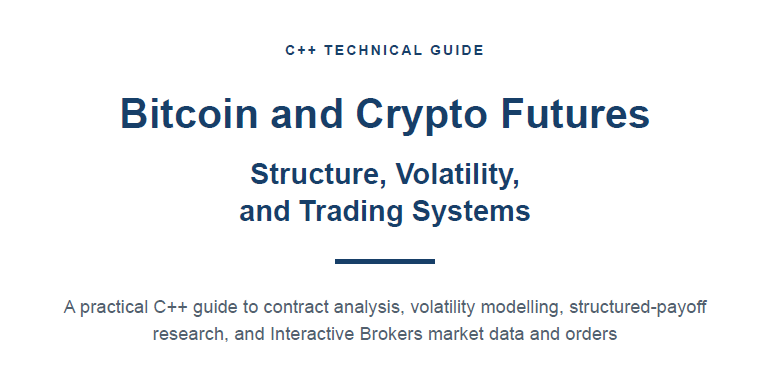
Bridge the gap between quantitative derivative modeling and direct broker execution. Bitcoin Futures, Volatility Analytics, and IBKR Integration is a comprehensive, 59-page technical implementation guide and architectural blueprint for building automated, risk-controlled trading systems in modern C++17 using the Interactive Brokers (IBKR) TWS C++ API.
⚡ What You Get Inside This Guide
-
Full C++17 Analytics Header (
CryptoAnalytics.hpp): Complete, zero-dependency mathematical library including Black-76 European options pricing, Greeks (Delta, Gamma, Vega), bounded numerical implied volatility inversion, log returns, sample historical volatility, realized variance, and EWMA volatility modeling. -
End-to-End IBKR Integration Module (
CryptoSession.hpp): A robust, event-driven C++ integration layer interfacing directly with the Interactive Brokers TWS API (EClientSocket/EWrapper) for CME Micro Bitcoin futures (MBT).
-
Deterministic Risk & State Machine Architecture: Multi-state order lifecycle management (Handling timeouts, partial fills, stale quote invalidation, spread-width limits, and recovery gates).
-
Structured Payoff & Monte Carlo Engine: Research algorithms for volatility-linked and variance-linked notes, basis term structure monitoring, and calendar spreads.
🛠 Core Technical Specifications
| Language Standard | ISO C++17 (Standard library only; zero third-party math bloat) |
| Broker API | Interactive Brokers TWS C++ API (EClientSocket / EWrapper) |
| Target Instruments | CME Micro Bitcoin Futures (MBT), Standard BTC Futures, Basis Spreads |
| Format | Direct PDF Download (59 Pages, Full Annotated Code Listings + Architectural Diagrams) |
📖 Table of Contents & Key Modules
1. Real Derivative Economics vs. Contract Multipliers
- Differentiating cash-settled CME futures (5.0 BTC vs. 0.1 MBT) from spot and perpetual swaps.
- Exact P&L mechanics, integer tick calculations, and passive limit rounding routines.
- Economic notional vs. maintenance margin: Modeling cash-demand stress tests and adverse price shocks.
2. Quantitative Volatility & Pricing Library
- Historical & Realized Volatility: Demeaned log returns vs. continuous realized variance across custom calendar configurations.
- Black-76 Implementation: Complete, numerically stable pricing and exact analytical Greeks for options on futures.
- Implied Volatility Solver: Fast, bounded bisection algorithm with strict error bounds.
- Term Structure & Basis: Simple vs. log-annualized basis metrics and calendar spread execution risks (legging risk mitigations).
3. Direct Interactive Brokers (IBKR) Integration
- Connecting to TWS / IB Gateway via dedicated C++ reader threads.
- Automated Contract Discovery: Ambiguity checks, local symbol resolution, multiplier validation, and security type verification.
- Quote Integrity Engine: Rejecting crossed, zero-volume, or stale quotes using monotonic clock timestamp tracking.
- Market Data Modes: Managing Live (1), Frozen (2), Delayed (3), and Delayed-Frozen (4) data callbacks.
4. Order Lifecycle, Execution Gates & System Recovery
- Non-blocking state-machine design: Created → Validated → Submitted → Acknowledged → Filled / Cancelled → Uncertain.
- Fail-safe account gates: Empty-position snapshots, notional ceiling controls, and what-if margin previews.
- Handling disconnections (Errors 1100, 1101, 1102) and automated session-recovery validation procedures.
🎯 Who Is This For?
- Quantitative Developers: Looking for a clean, tested C++17 reference architecture to hook into the official IBKR C++ API.
- Prop Traders & Quants: Trading CME crypto futures seeking robust basis tracking, volatility calculations, and pre-trade margin safety gates.
- Engineering Students & Quants-in-Training: Wanting clear, real-world examples of how production trading code differs from backtesting sandbox notebooks.
Note on Software Integrity: All code listings are fully exposed in plain text within the document for immediate extraction, compilation, and unit-testing. Designed for supervised simulation/paper trading before any live deployment.
Share